![myblog-sea-how-flexible-office-space-can-cut-your-business-costs-across-southeast-asia-in-2026-cl.jpg]()
How many days a week does your team need to be in the same room, and who decides? Those are the questions behind hybrid work, an arrangement in which people split their working week between a shared office and somewhere else, such as home.
A hybrid team keeps in-person time for the work that goes better face to face, such as planning sessions, onboarding new staff and client meetings, and does the rest remotely. Where that balance sits affects how people work together, how much office space the business needs and how clients get hold of the team on days when most desks are empty.
What Makes an Arrangement Hybrid
Every hybrid arrangement settles three practical points: where people work on each day, how often the team comes together and who chooses the days. A small team may agree these in a conversation, while a larger one may put them in writing. Either way, the arrangement sits between office-based and fully remote work.
|
|
Office-based
|
Hybrid
|
Fully remote
|
|
Where people work
|
The same office every working day
|
Partly in a shared office, partly at home or elsewhere
|
At home or another place of their choosing
|
|
Time together in person
|
Every day
|
On set days or when needed
|
Occasional meet-ups, if any
|
|
Office space
|
A desk for each person
|
Can be smaller, with shared desks
|
Little or none
|
|
Suits
|
Hands-on, front-line and in-person service roles
|
Teams that need both quiet focus time and face-to-face collaboration
|
Work that can be done fully online
|
Four Common Ways to Set Up Hybrid Work
Hybrid work models differ mainly in who picks the office days and how many there are. A team can follow one of these four or blend two of them.
1. Set Office Days for Everyone
The business picks the office days, and the whole team comes in on them. Meetings and reviews go on the shared days, and nobody arrives at an empty office. The trade-off is less individual choice, and the office still needs room for everyone on those days.
2. Office-First With Some Days at Home
The office stays the main place of work, and people can work from home on one or two days a week, or when a task needs quiet. This can suit teams that serve clients in person while still giving staff some days without a commute.
3. Remote-First With Planned Get-Togethers
Most work happens at home, and the team meets on a regular schedule, perhaps weekly or for a monthly planning day. With fewer natural moments together, keeping people connected takes more deliberate effort, such as regular check-ins and a clear purpose for each meet-up.
4. Days Chosen by Each Person
Each person decides when to come in, based on the work in front of them. This flexible approach gives the most freedom, but someone can travel in only to find the colleague they needed has stayed at home. A shared calendar of who plans to be in can help.
A Hybrid Week for a Metro Manila Team
Picture a six-person marketing agency whose staff live in different parts of Metro Manila, setting two office days and keeping the other three for working from home.
Putting meetings on the shared days leaves the home days free for focused work, and for staff who cross the city, each home day saves a return trip through traffic. When heavy rain or flooding makes travel hard, a team that already works from home part of the week may find it easier to carry on, since that day can run like any other home day.
Benefits and Trade-Offs for a Small Business
For staff, a hybrid week can give back time and improve work-life balance, with fewer days on the road. For the business, it can make a long commute easier for new hires to accept, widening the area it can recruit from, and it may mean leasing less office space.
There is also evidence on retention. A six-month trial with 1,612 graduate employees at Trip.com, a Chinese travel technology company, ran in 2021 and 2022. Offering the option to work from home on Wednesdays and Fridays reduced quit rates by one-third compared with colleagues who came in every day. The fall was statistically significant for non-managers, women and employees with long commutes, and performance grades over the following two years showed no difference, according to the study published in Nature in 2024. The results come from one company in China and may not carry over to a Philippine business.
Several of the drawbacks are about coordination. Meetings need planning around office days, chance conversations happen less often, and people who are in the office more may get more notice than colleagues at home. Staff who work mostly from home can also feel cut off.
Some roles cannot be done away from the premises at all, and home setups vary, from the internet connection to a quiet corner for calls. Questions about the employment side of working from home are best taken to the Department of Labour and Employment (DOLE) or an employment adviser.
Space for the Days the Team Meets
How often the team meets, and how many people come in at once, decides what kind of space it needs. These options can be combined:
- A smaller permanent office. When people come in on different days, desks can be shared, and the office may need fewer desks than there are staff.
- Coworking space. Memberships give people a place to work away from home, and the space can double as the meeting point on in-person days.
- Meeting rooms hired as needed. A remote-first team can book a room only when it needs one, for a workshop, a quarterly review or a client presentation, with no office to maintain in between.
One Number and One Address for a Team in Several Places
Clients and suppliers do not see the rota. What matters to them is a phone number that someone answers and an address where post arrives, whoever is in that day. Without them, personal mobile numbers can end up on business cards, and deliveries can arrive at an empty office or a team member's home.
A virtual office phone service is one way to cover the calls: a receptionist answers the business line and passes each call to whoever is working that day. A business address with mail handling does the same for letters and parcels.
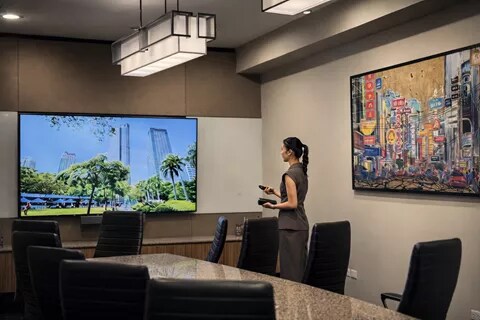
Servcorp's Virtual Office Package at PSE Tower in Bonifacio Global City is one example. It pairs a local phone number, answered in your company's name by a dedicated receptionist, with an address for business cards and marketing materials, and includes mail and courier handling. Boardrooms and meeting rooms can be booked for as little as 10 minutes or the entire day when the team meets in person, and contracts run month by month.
Testing a Pattern Before You Settle on It
A hybrid arrangement can change as the team learns what works, so the first version does not need to be final. Try a pattern for a couple of months, ask the team what helped and what got in the way, and adjust from there. Whatever the pattern, let clients know how to reach the business and how to arrange a meeting, so nobody makes a wasted trip.
Frequently Asked Questions